• Home
  • About
  • Artwork
  • Exhibitions
    • ALMOST
  • Contact
ALMOST, 2026.
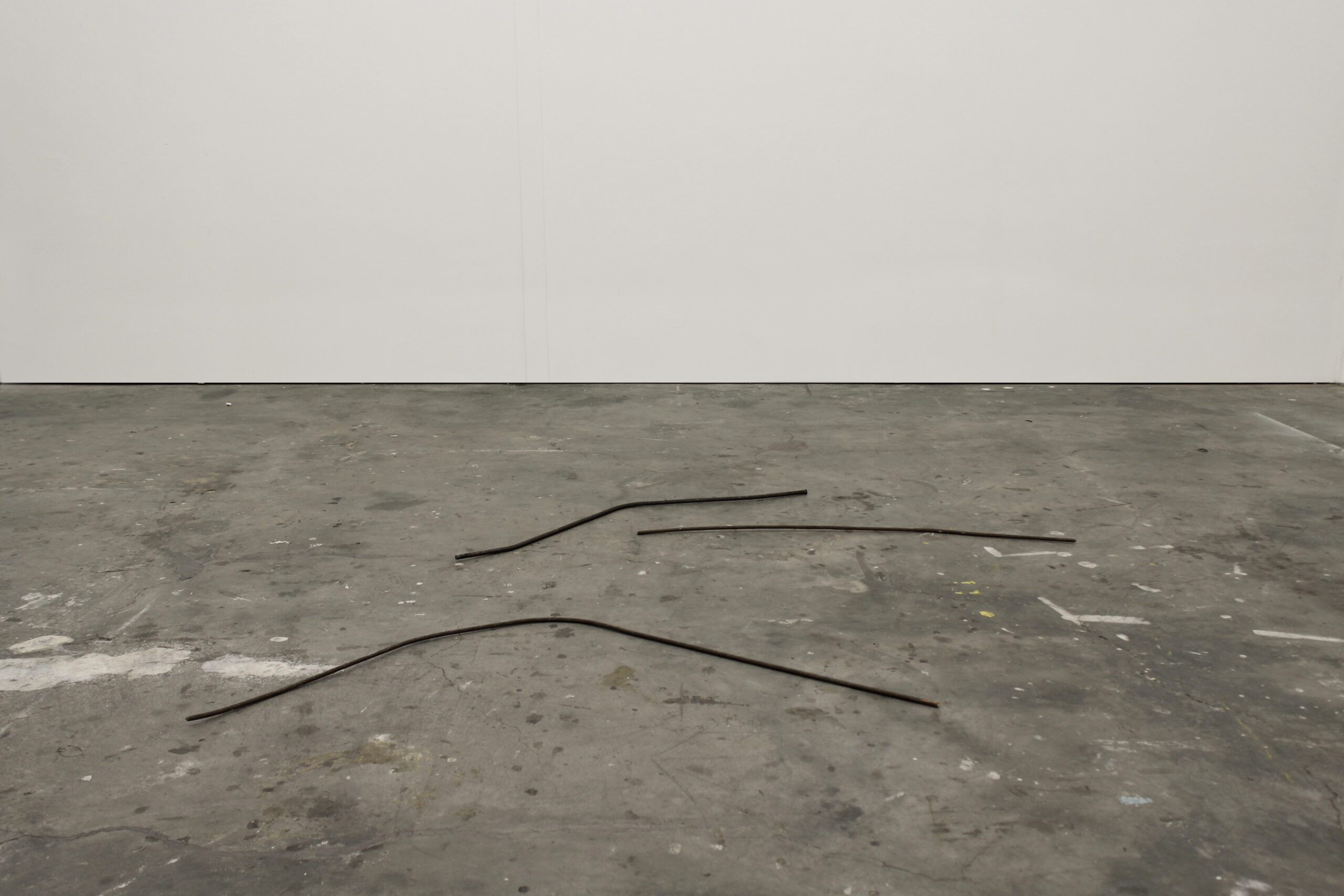
A METER THREE TIMES, 2014. BENT STEEL. DIMENSIONS VARIABLE

studio.coleman

RUANN COLEMAN archives
- Follow Visual Diary @ruann_coleman

Flip I, 2018. Wooden tables Dimensions Variable Flip I, 2018. 
Wooden tables 
Dimensions Variable 

What appears at first as two tables quietly misbehaving is, in fact, a familiar gesture within the Coleman’s practice: a refusal of use in favour of attention. By lifting the table out of its expected horizontal contract with the body, the work interrupts habit. The object no longer offers itself as a surface for action, but stands instead as something to be encountered—measured not by function, but by presence.

Installed during a conceptual sculpture workshop the artist gave at the Visual Arts Faculty at Stellenbosch University in 2018, the work consists of two tables repositioned into a vertical orientation. Their forms remain legible (edges, legs, planes still intact) yet their logic is unsettled. Leaning rather than standing, they occupy space with a quiet instability, hovering between furniture and figure. This moment of suspension is central to the Coleman’s broader concerns: balance without symmetry, structure without utility, and the subtle tension between control and collapse.

Materially restrained, the work relies on weight, proportion, and gravity to perform its meaning. The tables read almost bodily  upright, vulnerable, negotiating their own stance within the room. In this way, the installation aligns with an ongoing practice that repeatedly returns to modest gestures and everyday materials as a means of recalibrating how bodies, objects, and spaces relate. The work does not declare itself; it waits, allowing the viewer’s own sense of measure to complete it. 

#art #artist #artwork #installation #ruanncoleman
Stay is a series of site-specific interventions th Stay is a series of site-specific interventions that collapses artwork, framework, and backdrop into a single gesture. Each piece is formed from fallen twigs—materials with no assigned value—reintroduced into the urban fabric as momentary inscriptions. By placing these organic fragments onto the surfaces of cities, the series negotiates how context shapes meaning, how placement becomes content, and how the simplest gesture can reconfigure the way a place is seen.

In Venice, Stay takes the form of organic graffiti, a counter-mark to the inscriptions the city usually carries. Instead of pigment or declaration, these gestures arrive softly: twigs gathered from the ground and placed against walls weathered by centuries of tide and touch. They mark the surface without altering it, using what the city has overlooked to propose a different kind of authorship—one that is temporary, quiet, and collaborative with place rather than imposed upon it.

Venice is a city defined by its negotiation with historic impermanence. Stone clings to its foundations while water writes and rewrites the edges of every building. Within this suspended architecture, the twigs become a kind of mirror. Their presence is slight, almost breath-like, yet they echo the city’s own fragility. The gesture turns Venice’s myth of timelessness inside out, revealing instead a place held together by continual repair, soft erosion, and the delicate persistence of things that are never fully secure.

Placed on these walls, the twigs become momentary punctuation—a brief natural script interrupting the ornate surfaces around them. They ask nothing more than to be noticed before they disappear. Their fate is bound to the city’s daily rhythms: they may fall, be swept away, brushed aside, or carried off by wind. This eventual erasure is not a loss but part of the work’s architecture, a reminder that attention itself is a fragile, fleeting act—and that beauty often resides in what barely stays at all.

#Art
#Artist
#Artwork
#Installation
#RuannColeman
#SiteSpecific
#Twigs
#OrganicGraffiti
#Venice
3/1, 2016. Walnut and enamel 62 x 85 x 7 cm 3/1 3/1, 2016. 
Walnut and enamel
62 x 85 x 7 cm 

3/1 extends the artist’s ongoing enquiry into measurement as both concept and autobiography. As in earlier works, the artist’s own length becomes the fundamental unit—the body acting as origin, tool, and subject. Each rectangular form corresponds to this personal measure, cut and reassembled into a progression of tilted volumes that lean forward, suggesting motion through space. What begins as a single datum becomes a sculptural language of repetition, rhythm, and variation.

Here, measurement is not a neutral system for quantifying distance but a way of thinking: a method for translating lived scale into form. The three frames unfold almost like steps, breaths, or moments—each identical in dimension yet shifting in orientation, revealing how the same body can articulate itself differently across space and time. In this sense, the work becomes a diagram of presence, marking the intervals through which a body imagines and inhabits its environment.

There is an implicit dialogue with artists such as Antony Gormley, whose explorations often map or abstract the human figure into geometric volumes. Yet where Gormley extrapolates from the figure itself, 3/1 abstracts the body into a repeated interval—an arm’s-length, a reach—turning anatomy into architecture. These forms act almost as autobiographical structures, outlining not the figure but the measure from which the figure understands the world.

The subtle yellow pigment at the top edges interrupts the sober geometry with a moment of emphasis, reminding the viewer that every system of measurement contains points of attention and interpretation. These small marks operate like highlights or footnotes, signalling specific moments within an otherwise uniform sequence.

Through its leaning formation and charged negative spaces, 3/1 proposes volume as something closer to movement than mass. The voids between the frames feel active, like the pauses between gestures. Ultimately, the work treats measurement as a lived experience—an intimate scale through which the artist traces not just physical length but the shifting ways a body occupies and imagines space. 

#ruanncoleman
Wait II 2017 Steel, Rock 67 × 50 × 40 cm Wait I Wait II
2017
Steel, Rock
67 × 50 × 40 cm

Wait II stages a quiet negotiation between weight and line, between the grounded certainty of stone and the tentative gesture of steel. At first glance, it appears almost impossibly simple: a rock, a frame, a slender branch-like arm of steel. Yet simplicity here is deceptive; the work is a study in how materials hold, lean, interrupt, and listen to one another.

The steel frame behaves less like a support and more like a question. It outlines a space, proposes a boundary, and then immediately breaks it by allowing the rock to breach its lower edge. The frame doesn’t contain the stone; instead, it adapts to it, tilting ever so slightly under its weight. This shifts the work from a static object to a moment of balance—an event unfolding in the present tense.

Above it, the line of steel reaching upward echoes the delicacy of a twig. It introduces an unexpected softness, a contrast to the grounded mass below. This thin gesture gives the sculpture its breath, its pause, its sense of waiting. The composition becomes a conversation between two forces: the heavy and the slight, the geological and the ephemeral, the fixed and the reaching.

In Wait II, materials are not used for what they traditionally do, but for what they can suggest. Steel performs like a line drawn in space; rock becomes a counterweight in a poised equation; the frame shifts from structure to threshold. Together, they create a moment of suspension—an image of waiting not as idleness, but as attention. It is the moment just before something changes, when even the smallest shift could tilt the whole.

#ruanncoleman #art #artist #Installation #Sculpture #Line #Shapes #Form #Gallery
Curve II, 2019. Mild Steel From the solo present Curve II, 2019. 
Mild Steel

From the solo presentation in between, CUBICLE SERIES, Everard Read

In Curve 2, a simple bend becomes a site of attention. A length of metal—disciplined, industrial, unapologetically linear by nature—is coaxed into a gesture that feels almost human. Its arc holds both resistance and release: the moment where the rigidity of the material gives way just enough to produce a curve, and where geometry shifts from being a system of measurement to a moment of expression.

Suspended against the wall, the work reads as both drawing and sculpture. The metal behaves like a line lifted off the page, occupying space while still behaving like a mark—a gesture held in mid-air. Its colour sharpens that reading: a deep, saturated blue that compresses shadow and surface into a single continuous thought. As the light changes, the work throws a faint, elongated echo onto the wall, as though the curve is whispering its own afterimage.

The piece sits precisely within the exhibition’s title, in between. It occupies the interval between object and sign, between engineering and intuition, between the strictness of material and the softness of movement. The curve becomes a hinge—linking what metal “should” do, and what the artist asks it to do. That negotiation is the quiet heartbeat of the work.

Curve 2 ultimately reveals that within the hardness of metal lies a surprising capacity for grace. Through a single, precise bend, the artist invites the viewer to consider how far a material can be taken before it becomes something entirely new—and how meaning often resides not in the extremes, but in the delicate space in 

#Curve 
#InBetween 
#EverardRead 
#Contemporary
#Sculpture 
#Minimal 
#MaterialPoetics 
#exhibition 
#art 
#artist
#ruanncoleman
Sculptorvox: The Geometry of Nothing (Vol. 01) Ru Sculptorvox: The Geometry of Nothing (Vol. 01)

Ruann Coleman was featured in the inaugural edition of Sculptorvox, titled The Geometry of Nothing, a publication dedicated to exploring contemporary sculpture and expanded material practice across international contexts. This first edition positioned itself as a dialogue between artists, writers, and theorists who investigate the thresholds between form and absence, structure and meaning - themes that resonate deeply with Coleman’s own practice.

In his contribution, Coleman discussed the philosophical underpinnings of his sculptural work, particularly the relationship between balance, material agency, and the poetics of tension.
The interview examined how objects can hold states of becoming
- suspended between gesture and event - and how the smallest shift in weight or measure might alter perception entirely.

Through this conversation, Sculptorvox presented Coleman’s work within a broader discourse of minimal intervention and conceptual materialism, aligning his approach with a generation of artists whose practices redefine the boundaries of sculpture through process, restraint, and philosophical inquiry. The feature illuminated the quiet geometries present in Coleman’s installations - spaces where absence itself becomes a form of presence.

Interview by Daniel Lingham

FEATURED ARTWORKS 

- Stay I, 2015.
- ‘The Distance Between Us’ I, 2017
- Stretch I, 2017. 
- Drift I, 2017. 
- Faktura I, 2017. 
- Embrace I, 2017. 

#art #artwork #artist #interview #geometryofnothing #sculptorvox #ruanncoleman
Cipher Stick I, 2017. ‘IF YOU ONLY LOVED ME THI Cipher Stick I, 2017. 
‘IF YOU ONLY LOVED ME THIS MUCH’
Painted Wood
6m

Cipher Stick II, 2017. 
‘WHEN WILL MY WORDS REACH YOU’
Painted Wood
6m

Cipher Stick III, 2017. 
‘THE DISTANCE BETWEEN US’
Painted Wood
5,5m

Cipher Sticks
Part of the exhibition Words, Nirox, 2017

The Cipher Sticks extend the logic of the artist’s A1Z26 cipher poems into the landscape—letters turned to numbers, and numbers into form. Each yellow yardstick becomes a vertical line of language, a column of coded rhythm reaching toward the sky. What was once written small, hidden within a notebook or etched on the surface of a measuring tape, is now scaled into monumentality.

In these towering measures, scale becomes both a question and a statement. The language of precision—used to build, to measure, to compare—is reimagined as a poetic structure. The act of measurement, usually one of control and standardisation, turns here into a gesture of openness and ambiguity. Each number is both a unit and a syllable, a point on a scale and a fragment of a hidden message.

By enlarging the cipher to the height of a person and beyond, the artist invites the viewer to inhabit the poem physically. The coded script rises above eye level, evoking a sense of wonder and dislocation; one must look up to read, to imagine, to interpret. The sticks measure not distance or height, but language itself—stretching the invisible space between meaning and material.

These works continue the artist’s exploration of how systems of order—metric, linguistic, spatial—are never neutral. Here, measurement becomes metaphor, and numbers become a quiet code of communication, reminding us that all attempts to quantify carry within them a longing to understand, to reach, to speak across distances. 

#art #artist #artist #ruanncoleman #cipherpoems #a1z26code #nirox #installation #sculpture
Untitled (Bundles / Pages), 2017. Found branches, Untitled (Bundles / Pages), 2017.
Found branches, ratchet strap, pulley

These gathered branches hang together like the pages of an unwritten book. Each twig is a line, each knot a comma. Their arrangement holds a suspended syntax—an unwound paragraph of the forest. Paper begins here, in the branching of a tree, long before it is pulped, pressed, and ruled into lines.

In this work, the artist returns language to its origin—the tree as archive, the branch as sentence, the bundle as bound volume. What might have been a stack of pages remains instead in potential, its stories uncut, untold. The orange strap becomes a single binding line, a thread of tension that keeps language from falling apart.

Information grows from trees; knowledge is a form of photosynthesis. The light that falls through these branches is the same light that once fed the paper on which words are written. In this suspended moment, language is not yet printed—it is growing, breathing, leaning toward meaning.

#art #artwork #artist #ruanncoleman #nirox #sculpture #installation #twigs #branches #poems #words #readingdifferently
I Am Trying to Reach You 2017 Wood, Mild Steel, Ce I Am Trying to Reach You
2017
Wood, Mild Steel, Ceramic, Copper Wire & Duct Tape
13 × 6 × 5 m

Part of the WORDS exhibition at Nirox sculpture foundation in 2017. 

What once carried voices now carries silence. In I Am Trying to Reach You, the artist reconstructs the form of a telephone line—an early emblem of human connection—into a sculptural echo of longing. Two poles lean toward one another, tethered by thin wires that once promised proximity, now stretched across a distance that feels both physical and metaphoric.

The work reflects on the evolution of communication itself: from slow transmission to instantaneous noise, from the measured exchange of words to the relentless pulse of digital chatter. In this landscape of accelerated messaging, the artist reclaims stillness. The handmade construction, its modest materials—wood, copper, ceramic—recall a time when communication was tangible, carried through breath and gesture rather than data and display.

Through this reconstruction, the artist critiques the erosion of intimacy in the age of immediacy. The poles, straining to meet, embody the impossibility of dialogue in a world saturated by signal yet emptied of meaning. It is an appeal for the quiet frequency—the whisper that survives beyond the static. 

Image Credit @itsnathankru 

#art #artist #artwork #ruanncoleman #nirox #sculpture #installation #telephonepoles #telephonelines #lines #iamtryingtoreachyou
Ode, 2017. Twig, photograph, tape Part of Certain Ode, 2017.
Twig, photograph, tape

Part of Certain Lengths, SMAC Gallery, Cape Town

In Ode, a simple arrangement becomes a conversation across time — a found twig, a photograph of Marcel Duchamp, and a strip of fluorescent tape. It is not a portrait, nor a quotation, but a continuation of thought. Duchamp’s proposition of the readymade — that an object can shift from the ordinary to the conceptual through attention alone — finds quiet resonance here. Yet where Duchamp framed the object within the space of the mind, the artist reintroduces measure, touch, and proximity.

The twig acts as a line of encounter — drawn not by hand but by circumstance — a mark that measures relation rather than distance. Its placement across the image turns composition itself into a form of measurement, a means of testing balance, attention, and the fragile boundaries between what is found and what is made. The tape becomes both tool and signifier: a mark of fixing, framing, and holding, but also of interference. It underscores the blurring of categories that both artists embrace — between object and image, between gesture and thought.

In Ode, the dialogue with Duchamp becomes tactile. The work considers how meaning moves through materials — how a readymade can become a site of measurement, and how composition itself might serve as a form of inquiry. It is through these small, deliberate acts that the artist continues the lineage of questioning: where does the object end and the idea begin, and how might one be measured through the other? 

#art #artist #artwork #ruanncoleman #marcelduchamp #twig #tape #image #composition #readymade
Within Certain Lengths, a solo show at Smac Galler Within Certain Lengths, a solo show at Smac Gallery Cape Town in 2017, the artist extends his exploration of measurement into the terrain of language itself. These works—cut fragments of yellow measuring tape, each inscribed with numbers—compose what might first appear as a collection of data, remnants of something once whole. Yet these are not measurements of distance, but of meaning. Each number conceals a letter; each fragment, a word.

The poems are written through the A1Z26 cipher, where A becomes 1, B becomes 2, and so on until Z equals 26. 

But the system shifts in other poems — each time a letter reappears, it grows by twenty-six, expanding the code with each repetition. What begins as a child’s game becomes a layered poetic structure, where translation itself becomes a kind of measurement: an act of reassembling sense from fragments.

In these small yellow squares, language and mathematics fold into one another. They are quiet and systematic, yet alive with potential. The artist leaves them unresolved, suspended mid-thought. It is here that the viewer enters—not as a bystander, but as the other half of the work. Through the act of decoding, the viewer completes the gesture, translating number into voice, silence into rhythm.

What appears analytical is, in truth, deeply lyrical. What looks like absence is the possibility of speech. In these cipher poems, the artist turns the tools of measurement back upon themselves, revealing that every act of quantification carries within it a longing to understand. The line between measure and meaning collapses, and the work becomes a conversation—one that can only be completed in the mind of the viewer. 

Cipher poem I, 2017. 
‘If only you loved me this much’
Cut measuring tape + A1Z26 code
21 x 31 cm 

Cipher poem II, 2017.
‘When will my words reach you’
Cut measuring tape + A1Z26 + 26 Shift code
21 x 31 cm 

#art #artist #artwork #ruanncoleman #measurement #certainlengths #poems #ciphercodes #a1z26 #metaphor #distance
Part of an ongoing series of material studies feat Part of an ongoing series of material studies featured in Certain Lengths, solo show in 2017, with Smac gallery. 

‘Shapes and Sizes’ extends the ongoing material inquiry at the heart of Certain Lengths, where measurement becomes not only a tool but a way of thinking through form. Each work acts as a small experiment—an attempt to understand the distance between the body and the material world through touch, proportion, and intuition.

The series moves between precision and play: the artist’s own length is segmented into wooden cubes, then reassembled into an abstract rhythm of balance and extension. In another, a shard of PU foam—light, porous, and uncertain—contrasts with the grounded permanence of a found rock. Together, they create a quiet tension between weight and weightlessness, fragility and solidity.

Color too becomes a measure: the deep red of the rosewood, the soft yellow of the PU foam, and the ultramarine blue of the rock trace an unspoken dialogue with the primary palette of art itself. These hues are not chosen through calculation but through intuition—emerging as instinctive gestures that reveal how subconscious pattern and learned language coexist within material exploration.

As with many works in Certain Lengths, these studies resist resolution. They test what happens when control yields to curiosity, when structure bends toward sensation. In these forms—cut, painted, found, and reassembled—the artist continues to search for the meeting point between precision and wonder, where measurement becomes a kind of poetry.

#art #artist #artwork #ruanncoleman #gallery #exhibition #rock #blue #PUfoam ##rosewood #certainlengths #studies #materialexploration #measurements
The Distance Between Us, 2017. Two tape measures, The Distance Between Us, 2017.
Two tape measures, 
Dimensions Variable 

Part of Certain Lengths, SMAC Gallery, Cape Town

Two identical tape measures extend toward each other, their metallic bodies tethered by a single strip of yellow tape — a shared line of measurement that both connects and divides. What might first appear as a simple gesture — two tools meeting in precision — unfolds into a meditation on proximity, equivalence, and the impossibility of truly bridging the gap between one and another.

Here, the act of measuring becomes more than a technical operation; it becomes a metaphor for relationship. The tape — an instrument designed to quantify distance — becomes the very means through which distance is sustained. It reveals that every attempt to measure is also an act of separation, a reminder that to define something is to set it apart.

In this restrained composition, the artist turns the everyday object inward, letting it measure itself. The result is a quiet loop of dialogue — a conversation between two identical bodies, caught in the tension of knowing exactly how far apart they are, and yet never closing the space between them.

The simplicity of the work is monumental in its restraint. Like much of Coleman’s practice, The Distance Between Us takes a utilitarian object and reorients it toward poetics — showing that even precision instruments, built for certainty, can become instruments of doubt, tenderness, and reflection.

#art #artwork #artist #ruanncoleman #distance #metaphor #measurement #certainlengths
Drift, 2017. Eucalyptus tree 13 m Part of Certain Drift, 2017.
Eucalyptus tree
13 m
Part of Certain Lengths, SMAC Gallery, Cape Town

A single tree crosses a wall, holding its own weight as though suspended between two breaths. It extends through the room with quiet insistence — neither falling nor fixed — as if time itself were paused mid-gesture.

Drift turns balance into something felt rather than seen. The wall does not interrupt but measures; it listens. It holds the tension between what once grew toward the sky and what now leans into stillness. The branch, stretched and unwavering, becomes a drawn horizon — a line that both divides and connects.

There is something almost human in its poise: the way it reaches, the way it waits. The room seems to inhale around it, as though the tree’s presence has rearranged the air. Its weight rests lightly on the architecture, suggesting that support and resistance are not opposites but parts of the same gesture.

What makes the work monumental is not its size but its simplicity. In this suspended moment, the tree becomes a measure of patience — a quiet act of endurance. It reminds us that to hold something is not always to contain it; sometimes it is to let it hover, to trust that balance will find itself.

Drift stands as a pause in motion, a breath held long enough to remind us that stillness too can move.

#art #artwork #artist #ruanncoleman #installation #drift #wood #eucaliptus #balance #gallery
Stretch I, 2017. Rubberwood, steel rod Part of th Stretch I, 2017.
Rubberwood, steel rod

Part of the solo exhibition Certain Lengths, SMAC Gallery, Cape Town

Stretch presents a quiet paradox. Carved from rubberwood, the material itself refuses the very property its linguistic counterpart suggests. What once promised elasticity now holds its form in stillness, rendered rigid by the hand that shaped it. The work occupies a delicate space between humour and precision, illusion and revelation.

Engaging with the language of trompe-l’œil—literally “to deceive the eye”—the piece does not simply imitate; it meditates on imitation itself. By turning the pliable into the fixed, Stretch questions what it means to believe an object. The gesture is subtle, almost invisible, yet it provokes a quiet recognition of the tension between appearance and essence.

Here, the sculptural act becomes an act of linguistic play. “Rubber” and “rubberwood” fold into one another, revealing how language can both connect and betray material truth. The viewer is caught between knowing and seeing—between the impossibility of the object’s function and the tenderness of its making.

Within the broader framework of Certain Lengths, Stretch serves as a point of suspension. It holds within it the artist’s ongoing fascination with measurement, restraint, and the poetics of misalignment. The work resists monumentality, inviting the viewer to look closer—to question what is held, what is let go, and what stretches, invisibly, between perception and belief. 

#art #artist #ruanncoleman #rubber #wood #rubberwood #rubberband #sculpture #installation
Embrace (2017) Cast cement and belt 3.5 m (h) Edit Embrace (2017)
Cast cement and belt
3.5 m (h)
Edition 1/3
From the solo exhibition Certain Lengths, SMAC Gallery, Cape Town 

Three cast branches rise together in a quiet architecture of balance — a structure at once monumental and trembling. Bound by a single belt, they lean into one another as if testing the limits of their own endurance. The cement, heavy and unyielding, bears the imprint of once-flexible bark: what was once soft and temporary now stands in petrified stillness, its fragility paradoxically amplified through permanence.

There is a tension here between monument and moment — between the desire to preserve and the inevitability of loss. The branches, drawn from the forest and recast in cement, question what it means to hold something still. Does permanence strengthen or endanger what it seeks to protect? In making the fragile solid, the artist repositions delicacy as a form of strength — yet the sculpture’s poised instability reminds us that even monuments can tremble.

Within the wider context of Certain Lengths, Embrace continues the artist’s exploration of measurement, distance, and bodily presence. Like other works from the series—where parts of the artist’s body became rulers or sculptural units—this piece translates the ephemeral act of finding balance into a lasting form. The cement surface retains traces of bark and gesture, holding a memory of touch.

Ultimately, Embrace is less about the object and more about the space it negotiates—the invisible field of gravity, tension, and care that exists between things. It invites the viewer to consider how materials, like people, lean toward one another in order to stand; how what we call a monument might, in fact, be a moment caught in suspension. 

#embrace #art #artwork #ruanncoleman #asitist #sculpture #installtion #concrete #branches #belt #gallery #exhibition
Part of the Solo show, Certain Lengths, SMAC galle Part of the Solo show, Certain Lengths, SMAC gallery Cape Town, 2017. 

Auto Correct I is a sculptural inversion — a play on what supports, what is supported, and the precarious agreement between the two. A natural rock, seemingly unaltered, stands upright not on its own but by virtue of a cast bronze base that both props and contradicts it. The bronze, traditionally the exalted material of permanence and monumentality, becomes the stabiliser — the corrective — of the unhewn stone above it.

In dialogue with Constantin Brancusi’s philosophy of the pedestal, this work complicates the notion of where an artwork begins and ends. Brancusi famously declared that the base is not a support but part of the sculpture’s total form — an extension of its essence. Here, that lineage is re-examined. Coleman’s “base” is not carved or designed to elevate, but to steady what nature already made. It functions like a prosthetic, holding the stone upright, introducing an engineered precision beneath a geological accident.

The title Auto Correct suggests both digital intervention and intuitive adjustment — a moment where intention meets correction, or where error becomes form. The work holds in tension the impulse to ‘fix’ and the humility to let material dictate its own stance. The rock leans, slightly unstable, yet found in perfect equilibrium through its dependent bronze. The relationship between these two materials is not ornamental but conversational: each corrects the other.

In this way, Auto Correct I situates itself between monument and tool, between origin and translation. It proposes that correction is not an act of perfection but of relation — a quiet rebalancing of what stands, and why.

Auto Correct I, 2017.
Bronze and stone

Auto Correct II, 2017.
Bronze and polyurethane 

#ruanncoleman #auto #autocorrect #form #foam #rock #bronze #sculpture #art #artwork
Chafe Series (2017) Sandpaper Drawings Series inc Chafe Series (2017)

Sandpaper Drawings
Series included in Certain Lengths, SMAC Gallery, Cape Town

The Chafe series extends the artist’s inquiry into the poetics of labour, friction, and material resistance. Each drawing is made by pressing a sheet of sandpaper against a revolving belt sander—an act that burns through the fingertips and erases the very markers of identity that make touch possible. What remains is not an image but an index: a field of heat, abrasion, and residue.

By using sandpaper both as surface and subject, the work inverts traditional drawing—where the gesture of the hand produces line. Here, the line is produced through loss. The skin itself becomes the medium of inscription, leaving faint halos and scorched traces that recall both presence and erasure.

This series engages with the Constructivist notion of faktura—the emphasis on how material bears witness to its own making. The surface of Chafe I holds this testimony: each luminous scar in the darkness a record of pressure, friction, and endurance.

At once tactile and intangible, these drawings speak to the body’s negotiation with resistance—the point where touch transforms into pain, and making becomes a form of unmaking. In this gesture, the artist finds an equilibrium between material process and embodied language: a poetics of endurance where the skin remembers what the image forgets.

Chafe I, 2017
Sandpaper Drawing
27.5 x 22 cm

Chafe II, 2017
Sandpaper Drawing
27.5 x 22 cm

Chafe III, 2017
Sandpaper Drawing
27.5 x 22 cm

Chafe IV, 2017
Sandpaper Drawing
27.5 x 22 cm

#art #artwork #ruanncoleman #sandingpaper #drawing #chafe
In Certain Lengths, a Solo show, at SMAC Gallery, In Certain Lengths, a Solo show, at SMAC Gallery, Cape Town 2017, the artist turns the act of measurement into a gesture of translation — between body and object, presence and representation. Each wooden ruler, cut from rare timbers, corresponds to a specific length of the artist’s body: the width of a palm, the bridge of a nose, the span of an arm. These fragments become a portrait in parts — not of likeness, but of relation.

Influenced by Marcel Duchamp’s subversion of the everyday object, the work reconsiders the ruler not as a tool of precision but as a site of poetry. Where Duchamp displaced objects to expose the logic of art itself, Coleman re-embodies them — transforming the utilitarian into something intimate and fallible. The object is no longer detached; it bears the trace of touch, the imperfection of human scale.

Through this quiet intervention, Certain Lengths questions how systems of measurement shape our perception of truth, value, and form. The ruler — once an emblem of certainty — here betrays its own instability. Burnt edges and uneven grains mark the drift between accuracy and meaning, between the empirical and the emotional.

At its core, the work proposes that material and language operate under the same paradox: both seek to define what ultimately resists definition. Just as words can only approximate experience, measurement can only approximate the body. In this poetic space between precision and perception, Certain Lengths invites reflection on how we construct knowledge — not through numbers or words alone, but through the shifting distances between them.

Certain Lengths I, 2017.
Wild Pear, Satern, Kiaat, Zebrano, Walnut Wood
46.5 x 34 cm

Certain Lengths II, 2017.
Wild Pear, Kiaat, Rubber and Zebrano Wood
46.5 x 40 cm

Certain Lengths III, 2017.
Wild Pear, Rubber, Kiaat, Zebrano Wood
44 x 34 cm

Certain Lengths IV, 2017.
Wild Pear, Satern, Kiaat, Zebrano, Rubber, Walnut Wood
34 x 23 cm
Reach I, 2017. Wild olive wood 32 x 52 x 42 cm S Reach I, 2017.
Wild olive wood
32 x 52 x 42 cm 

Shown as part of SMAC Gallery’s booth at the Cape Town Art Fair in 2017, Reach continues Coleman’s ongoing exploration of gesture, distance, and connection through material form. Carved from wild olive, the work draws on the symbolic act of extending an olive branch — a gesture of offering, reconciliation, or truce — yet does so through quiet tension rather than overt sentiment.

The carved shapes suggest windows or viewfinders, openings that promise access while maintaining a certain remove. They offer sightlines through the work — glimpses of what might be shared — but the space between object and viewer remains charged, unresolved. From these frames, slender branches emerge, breaking through the edges as if attempting to bridge that distance.

In Reach, the material speaks of proximity and restraint at once. The work becomes a study in the desire to connect — to reach out — while recognising that the act itself is always marked by separation.
Follow on Instagram


                /
__.______/_.__/
   \        \